
Va-etchanan 5786
Ten (count ‘em, 10) Commandments

This week we are reading Parashat Va-etchanan (Deut 3:23–7:11). Longtime readers know that I often get hung up on a single word in the parashah; that’s not going to happen this week. This week I’m hung up on two words, and the two words I’m hung up on are: “Ten Commandments.”
Yes, the “Ten Commandments” from Exodus 20 are repeated in this whole long section of the Torah in which Moses is reminding the Israelites of what has gotten them to this point in the story, waiting on the east bank of the Jordan River, “in the steppes of Moab, across the Jordan from Jericho,” as they have been since the beginning of Numbers 22. You most likely remember that in Deuteronomy 5 Moses repeats the Ten Commandments with some interesting and extremely important variations. That’s not our subject today.
What I’m interested in talking about today is what the Ten Commandments are called — not in Deuteronomy 5, where Moses repeats them, but in Deuteronomy 4, where he reminds the Israelites about them. Moses says to them:
Deut 4:12 The LORD spoke to you out of the fire; you heard the sound of words but perceived no shape—nothing but a voice. 13 He declared to you the covenant that He commanded you to observe, the Ten Commandments; and He inscribed them on two tablets of stone. [NJPS]
In Modern Hebrew we call the Ten Commandments עשׁרת הדיברות aséret ha-dibrot, but that’s not what they’re called here. Here they are aséret ha-d’varim. D’varim is the plural of דבר davar ‘word, thing’. “The sound of words” in v. 12 is ק֤וֹל דְּבָרִים֙ qol d’varim, just the same Hebrew word that there are ten of in v. 13. It doesn’t, of course, mean a single word, in the sense of one word out of many words in a sentence or in a dictionary. It means a “word” in the sense of a message: What’s the good word?
And of course it can be used even more generally. That “thing” we were talking about is also a davar, and the word is used in the Bible the same way, as when “YHWH afflicted Pharaoh … because of the Sarai thing [עַל־דְּבַ֥ר שָׂרַ֖י]” in Gen 12:17. So Moses in Deuteronomy 4 is reminding the Israelites of the ten “things” that God told them in Exodus 20.
The word we use to name them now, dibrot, is the plural of the word דִּבֵּר dibber — not the verb meaning “he spoke,” which it perfectly resembles, but a noun meaning “an utterance,” or perhaps better “an Utterance,” which occurs just once or twice in the Bible:
Jer 5:13 The prophets shall prove mere wind
For the Word [הַדִּבֵּ֖ר] is not in them;
Thus-and-thus shall be done to them!”
Hos 1:2 When the LORD first spoke [תְּחִלַּ֥ת דִּבֶּר־יְ׳הוָ֖ה] to Hosea, the LORD said to Hosea …
Some consider this last to be a verb used like a noun, as in בראשית ברא of Gen 1:1; the King James Version, like the Greek translation, reads it as the Jeremiah noun. (My teacher Mayer Gruber, in his Hosea commentary, devotes more than four pages to this phrase.)
The previous verse, the beginning of Hosea, uses the plain-vanilla noun:
Hos 1:1 The word of the LORD [דְּבַר־יְ׳הוָ֣ה] that came to Hosea son of Beeri, in the reigns of Kings Uzziah, Jotham, Ahaz, and Hezekiah of Judah, and in the reign of King Jeroboam son of Joash of Israel.
That’s the word we would expect, and that’s what the Ten Commandments are according to this week’s parashah: the ten d’varim.
I said we’d be talking about two words today, so now I’m going to drop davar and go back to aséret ha-d’varim, the Ten Commandments. How do we know that there are ten?
Well, didn’t the Bible just say that there were?
Deut 4:13 He declared to you the covenant that He commanded you to observe, the Ten Commandments; and He inscribed them on two tablets of stone.
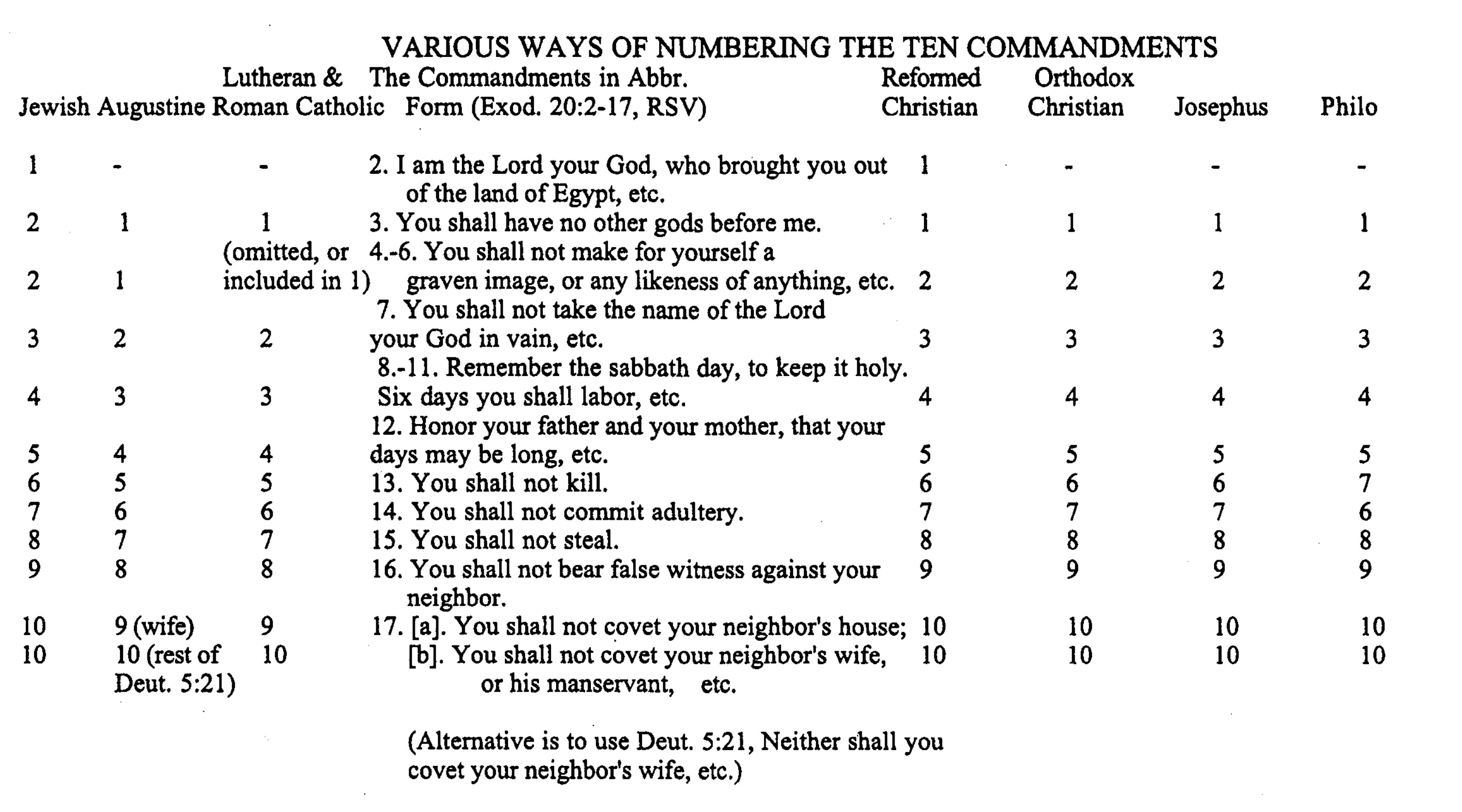
That’s what Moses said, to be sure, but when you go back to when God actually spoke the commandments, in Exodus 20, the text merely says, “God spoke all these words [הַדְּבָרִ֥ים ha-d’varim]” (Exod 20:1). Neither God nor Moses nor the Torah itself announces how many of them there are. That is why Jews and Christians disagree — not on how many commandments there are, but on which words belong to which commandment, or (more precisely) which words are a commandment.
According to us Jews, “I am the Lord your God” is a commandment. It sounds more like an assertion than an instruction, but accepting that assertion is understood to be a commandment. Here’s a look at some of the different ways of counting them:1
Yet Moses is not making up the number 10 in this week’s parashah. Instead, it indeed comes from Exodus, but not from the chapter whose contents Moses is repeating and (subtly) altering. Instead, it comes from Exodus 34.
After the Golden Calf incident, after YHWH has declared his 13 attributes to Moses, he has Moses make another set of two stone tablets, which the latter brings back up the mountain. Then:
Exod 34:10 He said: I hereby make a covenant. Before all your people I will work such wonders as have not been wrought on all the earth or in any nation; and all the people who are with you shall see how awesome are the LORD’S deeds which I will perform for you. 11 Mark well what I command you this day … 27 And the LORD said to Moses: Write down these commandments, for in accordance with these commandments I make a covenant with you and with Israel. 28 And he was there with the LORD forty days and forty nights; he ate no bread and drank no water; and he wrote down on the tablets the terms of the covenant, the Ten Commandments [עֲשֶׂ֖רֶת הַדְּבָרִֽים aséret ha-d’varim].
That, of course, is the same phrase that we have in this week’s parashah. Even in Exodus 34, where they are specifically called “ten,” it’s an interesting challenge to count ten commandments. I must ask again why there have to be ten when in Exodus 20 we’re not told how many there are.
It could, I suppose, just be an accident of history — perhaps literally an accident, as portrayed here. That’s one possible explanation. Another explanation is that ten is a mathematically “perfect” number, the sum of 1+2+3+4 that gives ten bowling pins that perfect triangle you try to knock apart.
Since we (most of us) have ten fingers, ten is a great number of something to have because it makes them easy to count — like, for example, the ten plagues that occurred in Egypt. How do we know that there were ten of them? Well, you can go to the book of Exodus and count them. They are much easier to count than the Ten Commandments are. In fact, they make a very nice pattern of three, three, three, and one.
Look in Nahum Sarna’s introduction to the plagues in the JPS Torah Commentary volume to Exodus, starting at 7:14, and probably in any other good commentary on the book of Exodus, to find a description of that pattern. There’s no way 3+3+3+1 can equal anything but ten, just like our bowling-ball pattern. Yet (as you’ll also see there) if you look at Psalms 78 and 105, which tell the story over again, each of those psalms describes only seven plagues.
So the truth is that we don’t know how many the Ten Commandments originally were. Were there 7? 10? 15 (thanks, Mel)? or just a bunch of incredibly important commandments that God announced, in a suitably imposing manner, and that at some point in biblical history the Israelites decided there must be ten of them? It is another one of the great unsolved mysteries of the Bible. No doubt we’ll meet another such puzzle next week — though probably not one of such consequence.
With apologies, I no longer remember the original source of this chart. See similarly the charts in Exodus 20 and Deuteronomy 5 in The Jewish Study Bible.