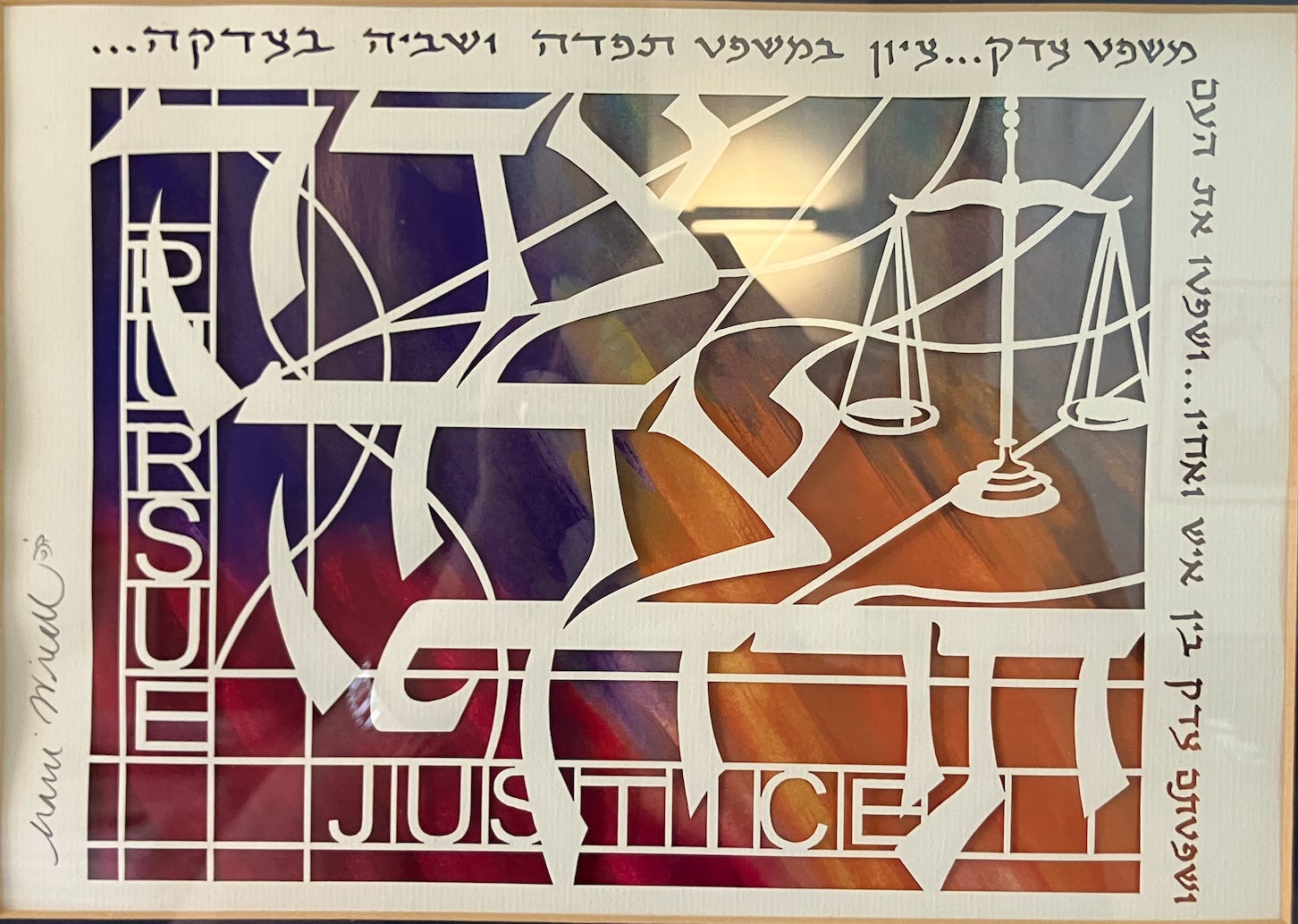
This week we are reading Parashat Shoftim, Deut 16:18–20:19, and, as is quite common, the name שֹׁפְטִ֣ים shoftim comes from the very first Hebrew word of our parashah:
Deut 16:18 You shall appoint magistrates and officials for your tribes, in all the settlements that the LORD your God is giving you, and they shall govern the people with due justice. 19 You shall not judge unfairly: you shall show no partiality; you shall not take bribes, for bribes blind the eyes of the discerning and upset the plea of the just. 20 Justice, justice shall you pursue, that you may thrive and occupy the land that the LORD your God is giving you.
A modern Israeli would think of shoftim and shotrim as meaning “judges” and “police,” but (more appropriately for Biblical Hebrew and biblical times) NJPS translates those words as “magistrates and officials.”
“You shall show no partiality” is more literally “you should not recognize a face” and therefore give the person special treatment. The instructions not to judge unfairly and not to take a bribe seem rather obvious. It’s the phrase following the instruction not to take a bribe that I want to talk about today. Somewhat unusually for the laws of the Torah in general, though common enough for Deuteronomy, the verse goes on to explain why you’re not supposed to take bribes:
Deut 16:19 הַשֹּׁ֗חַד יְעַוֵּר֙ עֵינֵ֣י חֲכָמִ֔ים bribes blind the eyes of the discerning
וִֽיסַלֵּ֖ף דִּבְרֵ֥י צַדִּיקִֽם׃ and upset the plea of the just
It’s quite clear that this is biblical poetic parallelism, and it’s equally clear this is not a poem. So this is poetic parallelism of the rhetorical kind. This is meant to be a very memorable phrase; that’s the purpose of this kind of stylistic writing. In this case, when I read it I thought: Gee, this sounds familiar. In fact, it sounds like something you would see in the book of Proverbs.
The difference between Proverbs and the Torah is that in Proverbs they are not so much telling you what to do as explaining the world to you. Here, Deuteronomy is doing just that kind of explaining: Bribery blinds the eyes of the ḥakhamim, the sage ones — who would otherwise be expected to rule intelligently — and twists the words of the tzaddikim, the (otherwise) righteous.
NJPS takes דבר davar to mean “thing” rather than “word”; it’s also possible to read it as I’ve suggested. Everett Fox translates, “twists the words of the equitable.” Whether it is the plea of the actually innocent (as tzaddik can also mean) that is overturned or the decision of the otherwise righteous judges that is twisted, an innocent person loses this case because a bribe has perverted justice.
Rather than pursuing that line of inquiry, we’re going to follow my instinct and take a journey to Proverbs — not only because of the way this verse sounds, but also because of a chain of thought that goes back, at the very least, to the book Deuteronomy and the Deuteronomic School by Moshe Weinfeld. Weinfeld proposes, and it is widely accepted, that Deuteronomy is really in the intellectual chain of the biblical wisdom tradition.
The wisdom books of the Bible — specifically Proverbs, Ecclesiastes, and Job — are really books of philosophy avant la lettre (and in the case of Ecclesiastes probably not really avant). They discuss the world from a human perspective. They are Jewish books, certainly, written in Hebrew and accepting the Israelite god, but reasoning out what the correct to thing to do should be. That is why Proverbs can adapt Egyptian wisdom and Ecclesiastes can quote the Epic of Gilgamesh.
In any case, I wanted to check whether this was indeed a proverb. In the old days you had to open a concordance, a book compiled over many years with great care by a dedicated scholar, to search for words that might be repeated in other places in the Bible. These days, a few clicks connect you to the right place.
The least common word in our phrase seemed to be סלף s-l-f ‘twist’, and a few keystrokes took me to the nine verses in the Bible where this verb occurs. Indeed, seven of the other eight examples come from wisdom literature: one from Job and a full six from Proverbs. Two of the examples from Proverbs are the noun סֶלֶף selef ‘perversity, deviousness’; the others are our verb. Here’s the example from Job:
Job 12:19 He makes priests go about naked,
And leads temple-servants astray.
The “leading astray” is done by our verb סלף.
Here’s an interesting example from Proverbs:
Prov 19:3 A man’s folly subverts [תְּסַלֵּ֣ף] his way,
And his heart rages against the LORD.
It is not the man’s evil nature that twists him, but his foolishness. Proverbs frequently compares evil with foolishness or wisdom with righteousness. That’s precisely what you see in our Deuteronomy verse, where the “synonym” of “wise” is “righteous.”
The bottom line, then, is that this is quite clearly another example of wisdom influence on the book of Deuteronomy. N’est-ce pas? No, I’m afraid not. The ninth example of סלף in the Bible, which is the really the first one a Bible reader would encounter, is from the laws of the Covenant Code:
Exod 23:8 Do not take bribes, for bribes blind the clear-sighted and upset the pleas of those who are in the right.
כִּ֤י הַשֹּׁ֨חַד֙ יְעַוֵּ֣ר פִּקְחִ֔ים וִֽיסַלֵּ֖ף דִּבְרֵ֥י צַדִּיקִֽים׃
It is exactly our same phrase, with one exception: The Deuteronomy verse calls the wise חכמים ḥakhamim, while the Exodus verse uses a fancier synonym: פקחים piqḥim — “the clear-sighted” in the NJPS translation. This verb פקח is used in Modern Hebrew to name the inspectors on the light rail who make sure you’ve swiped your card or scanned the QR code to pay; in Genesis 3, this is the what happens to the eyes of the original humans in the garden when they eat the fruit of the tree that was good for making you wise.
One other interesting difference is not the wording of this expression but its placement. In Exodus, it comes at the end of the Covenant Code, while in Deuteronomy the ס before v. 18 marks this paragraph as a beginning — and Jewish tradition has put it at the beginning of a weekly portion, the portion that serves as the basic text of Jewish political science. You must appoint “magistrates” throughout the country to rule on the law and “officials” to enforce their rulings; and “they shall govern the people with due justice,” equal, fair, and impartial.
Then the passage continues with these famous words:
Deut 16:20 Justice, justice shall you pursue, that you may thrive and occupy the land that the LORD your God is giving you.
Just about any Jew with any kind of serious connection to Jewish tradition knows these words, at least, in Hebrew: צֶ֥דֶק צֶ֖דֶק תִּרְדֹּ֑ף tzédek tzédek tirdof, ‘justice—justice!—shall you pursue’. That is the basis of any society that operates, as stable, free societies do, under the rule of law. If wisdom tells us anything, it tells us that. And laws, to the extent they are universal, are another aspect that can be shared between cultures, as indeed the Bible’s Covenant Code draws from the ancient Near Eastern legal tradition. So we see that the biblical wisdom tradition (a/k/a humans reasoning things out for themselves) did not have to wait for Deuteronomy and Proverbs to come along.